A Reflective Book Review for Leaders and Coaches
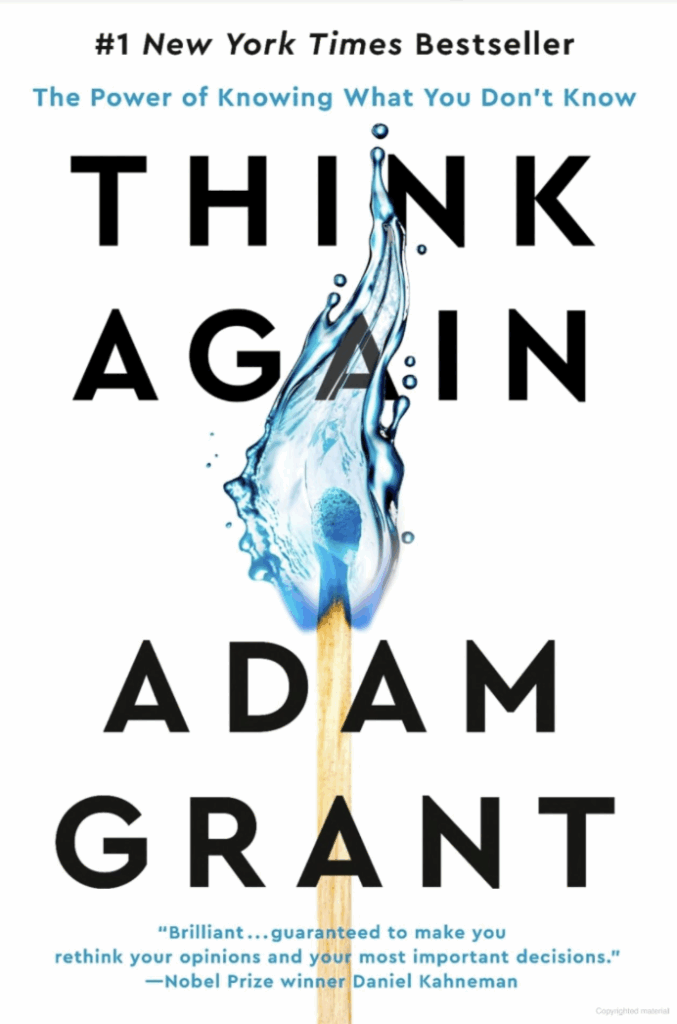 We live in a world that often rewards confidence more than curiosity, where being right can seem more valuable than being open. In Think Again, organizational psychologist Adam Grant invites us to consider a different path—one where wisdom comes not from holding tightly to our beliefs, but from the courage to question them.
At its core, Think Again is about the power—and the necessity—of rethinking. Grant makes a compelling case that our ability to revisit, revise, and sometimes even relinquish our ideas is one of the most important skills we can cultivate in a rapidly changing world. Whether we’re leading teams, parenting children, navigating conflict, or making personal decisions, the ability to pause and ask, “What if I’m wrong?” becomes a gateway to growth.
What makes this book especially timely is its relevance across domains. Grant explores rethinking on three levels: within ourselves, in our conversations with others, and in the cultures we create. Along the way, he introduces us to the mindsets that can keep us stuck—what he calls the Preacher, Prosecutor, and Politician modes of thinking. The preacher defends sacred beliefs. The prosecutor attacks opposing views. The politician seeks approval. All of them, he argues, make it harder to truly learn. The alternative? Thinking like a scientist—curious, humble, and grounded in the willingness to change one's mind in light of new evidence.
For those of us in leadership or coaching roles, this book offers not just insight but challenge. Grant reminds us that certainty is seductive, especially when we’re seen as experts or decision-makers. But confident humility—the ability to know what we know while staying open to what we don’t—may be the more powerful stance. In one of the book’s most memorable sections, he describes how effective leaders create space for dissent, invite counterviews, and model learning aloud, even in high-stakes environments.
Grant doesn’t preach from a distance. He shares stories of entrepreneurs who avoided collapse by questioning their own business models, teachers who transformed classrooms by normalizing mistakes, and individuals who used the tools of motivational interviewing to shift conversations that might otherwise have stalled in defensiveness. These examples, woven with research from behavioral science and psychology, offer a hopeful reminder: change is possible—even when it’s hard.
What stays with me most after reading Think Again is not a single framework or technique, but a feeling—a kind of quiet encouragement to lead with less armor and more openness. In a culture that often equates changing your mind with weakness, Grant argues that rethinking is a strength, a sign not of indecision but of wisdom.
For coaches, facilitators, and anyone guiding others through change, this book is more than useful—it’s resonant. It speaks to the practice of holding space for others to see what they couldn’t yet see, and to do the same for ourselves. As Grant writes, “If knowledge is power, knowing what we don’t know is wisdom.”
And perhaps, in the end, that’s the invitation: not just to think again, but to live again—more flexibly, more relationally, and more courageously.