• Skip to main content

Global Institute of Organizational Coaching

Global Coaching Certification

  • Explore Pathways
  • Dr Peggy’s Books
  • Resources
  • Log In
  • About

Book Reviews

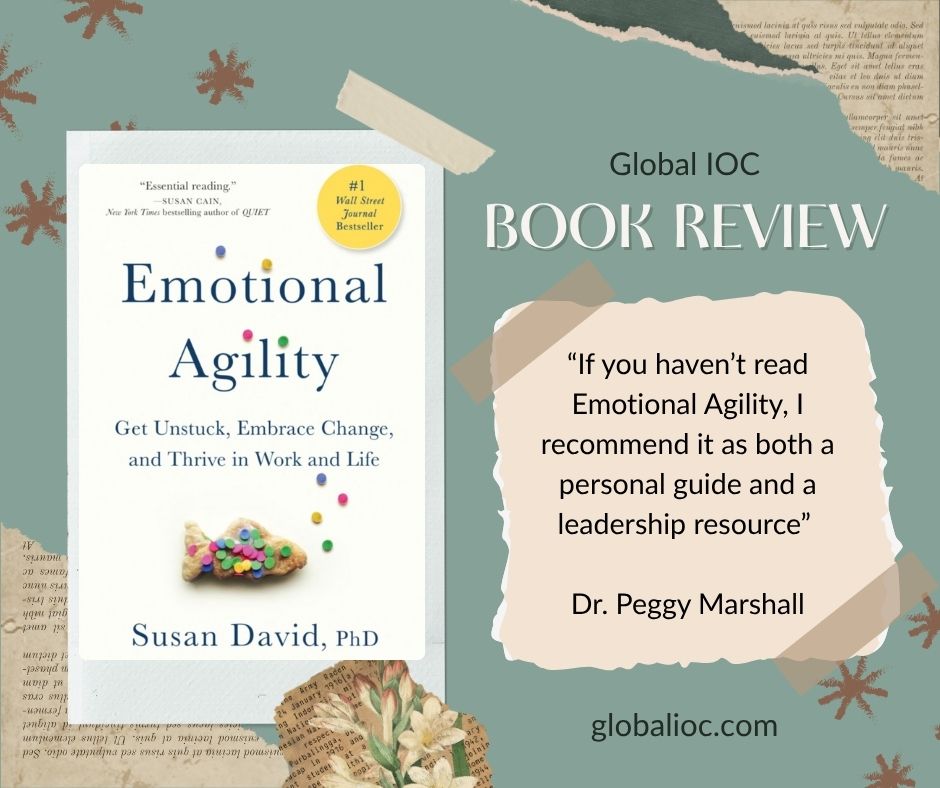
Book Review: Emotional Agility by Susan David

August 11, 2025 by Dr. Peggy Marshall

In today’s workplaces, technical skill alone isn’t enough. Leaders are called on to navigate ambiguity, high-pressure change, and the unpredictable human side of collaboration. In Emotional Agility, Harvard psychologist Susan David offers a research-based framework for one of the most critical—and overlooked—leadership capacities: the ability to work with emotions rather than be driven by them.

David defines emotional agility as the ability to be with your thoughts, feelings, and stories in a way that is flexible, values-driven, and constructive. In other words, it’s the skill of working with your internal experience rather than being run by it.

She identifies two traps that derail emotional agility:

  • Hooking – This happens when a thought or feeling grabs hold of you and drives behavior without reflection. You might find yourself replaying a perceived slight from a meeting, or making a decision out of frustration rather than careful consideration. Hooking often comes with urgency—the impulse to act now, defend yourself, or shut someone down—without pausing to ask if that’s really the most effective choice.
  • Fusion – Here, we merge with our thoughts and treat them as absolute truth. If you think, “They don’t respect me,” fusion makes it feel indisputable, even when it’s one interpretation among many. Fusion keeps us locked into one perspective and blinds us to nuance or alternative explanations.

David’s alternative is a process of four key practices that together create the flexibility, perspective, and values alignment leaders need.

  1. Showing Up – Rather than avoiding discomfort or trying to project “everything’s fine,” showing up means acknowledging what you feel—anger, anxiety, disappointment—and allowing it into your awareness without shame. In leadership, this builds authenticity and trust, showing others that emotions are part of the work, not a weakness to hide.
  2. Stepping Out – This is the mental shift from being inside the thought or feeling to observing it. You might notice, “I’m feeling defensive right now,” which creates distance and reduces the automatic power of the reaction. This is where reflection begins.
  3. Walking Your Why – Values become your compass here. When emotions are running high, asking “What matters most in this situation?” helps align your response with your deeper principles rather than your momentary reactions.
  4. Moving On – Emotional agility doesn’t mean waiting until the feeling passes; it’s about taking small, intentional steps that honor your values even while discomfort is present. Leaders who can “move on” demonstrate resilience and model for others that progress is possible without perfection.

For leaders, these skills are game-changing. Emotional agility allows you to respond to feedback without defensiveness, handle conflict without escalation, and remain grounded in the face of change. It’s the difference between being reactive in the moment and being responsive in service of the bigger picture.

At Global IOC, we see emotional agility as a cornerstone of coaching cultures. That’s why both our Registered Professional Coach (RPC) and Senior Registered Professional Coach (SRPC) programs include a full module dedicated to developing it. In these programs, we go beyond the theory—helping leaders apply emotional agility in real time:

  • Recognizing when they’re hooked by a narrative or reaction.
  • Practicing how to “step out” and create space between emotion and action.
  • Using values-based alignment to guide team decisions and conversations.
  • Building resilience by moving forward with small, meaningful shifts rather than waiting for the “perfect” solution.

This applied practice turns emotional agility from a personal competency into an organizational capability. When leaders model it, teams learn that emotions are not to be avoided, but understood and navigated. This creates a foundation of psychological safety, innovation, and adaptability—qualities every organization needs in today’s environment.

If you haven’t read Emotional Agility, I recommend it as both a personal guide and a leadership resource. And if you want to move from reading about it to living it in your leadership and coaching, our RPC and SRPC programs are the next step.

 

Filed Under: Book Reviews

Book Review: Shift by Ethan Kross

August 29, 2025 by Dr. Peggy Marshall

Ethan Kross, a neuroscientist at the University of Michigan and author of the bestselling Chatter, has spent years studying the inner voice that drives our emotions. In his new book, Shift: Managing Your Emotions—So They Don’t Manage You, he takes on an even bigger challenge: what to do with the powerful, often disruptive emotions that shape our thoughts, relationships, and decisions.

Emotions as Data, Not Disruptions

At the heart of Kross’s message is a reframe. Emotions aren’t problems to suppress, nor are they simply waves to ride out passively. They are signals—sources of information about what matters, what feels threatened, and what deserves attention. Instead of seeing emotions as “good” or “bad,” Kross invites us to treat them as pieces of data. The real skill, he argues, is learning how to shift our relationship with them before they spiral into patterns of rumination, conflict, or avoidance.

This shift begins in the body. Kross reminds us that emotions surge faster than conscious thought. Our amygdala and stress response light up in milliseconds, sending signals to tense muscles, quicken breath, and narrow focus. In those moments, we are primed for fight-or-flight rather than reflection or choice. His work highlights a truth many leaders and teams recognize daily: we often react before we realize what’s happening.

The Toolkit of “Shifters”

The most practical contribution of Shift is what Kross calls “shifters”—strategies to redirect the trajectory of emotion. These tools don’t deny the feeling; they interrupt its momentum and open space for a wiser response.

  • Sensory Shifters: Engaging the senses—through music, movement, scent, or even taste—can calm the nervous system and change our state almost instantly. For example, stepping outside for a few breaths of fresh air can signal safety to the body in ways words alone cannot.
  • Attention Shifters: Where we place attention determines whether emotion intensifies or softens. Kross suggests deliberately redirecting focus, sometimes through simple tasks, to loosen the grip of a strong emotion.
  • Perspective Shifters: Stepping back to reframe the story, ask how we’ll see the moment in a week or a year, or view the situation from another’s perspective helps us recognize that feelings are not the whole truth.
  • Environmental and Social Shifters: Our surroundings and relationships profoundly shape emotion. A cluttered space, a tense colleague, or a supportive friend all influence whether emotion escalates or eases. Choosing our environment—and the people we confide in—becomes part of managing emotion wisely.

What makes Kross’s approach so compelling is its grounding in both neuroscience and lived experience. His stories—from personal struggles to examples drawn from sports, business, and everyday life—illustrate that these shifts are not abstract theories but accessible moves we can make in real time.

The Power of Small Shifts

A key insight in Shift is that emotional regulation is not about monumental changes. It’s about a series of small, deliberate redirections that accumulate over time. A single breath, a quick reframe, a walk around the block—these minor interventions prevent emotions from calcifying into narratives or escalating into destructive behavior.

In leadership contexts, these small shifts make the difference between a reactive outburst that erodes trust and a thoughtful response that strengthens credibility. For teams, they can determine whether tension becomes drama or dialogue.

Where Shift Meets PAUSE

Reading Shift alongside the PAUSE model feels like finding two halves of the same whole. Kross provides the science and strategies—the “how” of emotional redirection. PAUSE offers the structure and intention—the “when and why.”

  • Pause and Notice mirrors Kross’s call to observe the body’s signals before they sweep us away.
  • Acknowledge What’s Present echoes his research on labeling emotions to reduce their intensity.
  • Uncover the Pattern parallels his perspective shifters, asking us to step back and see the bigger picture behind the trigger.
  • Steady and Shift is almost identical to his attention and sensory shifters—practices that regulate the nervous system so clarity can return.
  • Explore Options and Take Aligned Action reflects his emphasis on creating an “emotion roadmap,” where choice reopens after reactivity has passed.

Together, Shift and PAUSE remind us that we don’t need to eliminate emotions or fear them. We need to recognize them, work with them, and channel them into actions that reflect our values rather than our impulses.

Why Read Shift

For leaders and coaches, Shift is more than a book about emotion—it’s a guide to building environments where clarity, connection, and psychological safety thrive. When leaders model emotional regulation, they create space for others to do the same. When they use shifters intentionally, they interrupt cycles of drama and open pathways for trust and collaboration.

Paired with PAUSE, Kross’s work equips leaders with both the mindset and the mechanics for navigating high-pressure moments. It shows us that transformation doesn’t begin in grand gestures, it begins in the split second where we notice a feeling, steady ourselves, and choose to shift.

Final Reflection

Think of a recent moment where emotion nearly managed you.

  • What small shift might have changed its trajectory?
  • Which PAUSE step would have opened that space?

Ethan Kross’s Shift and the PAUSE model both affirm that emotions are not obstacles to leadership but invitations to deeper presence. Together, they offer a powerful playbook for interrupting drama, leading with intention, and turning moments of tension into opportunities for growth

Filed Under: Book Reviews

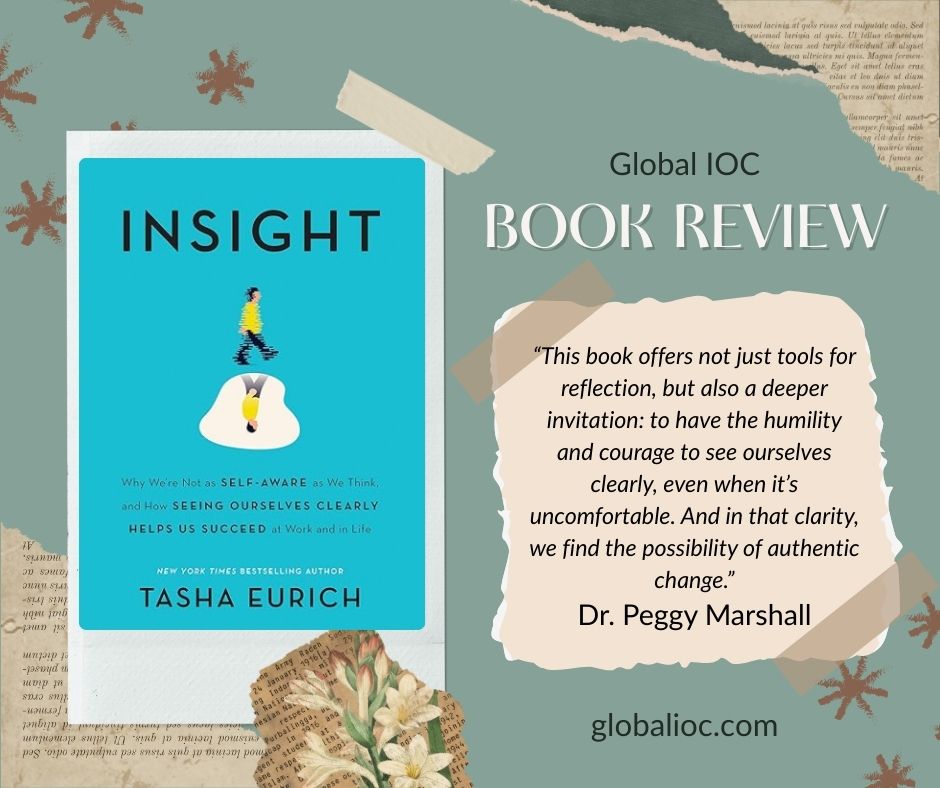
Book Review: Insight by Tasha Eurich

September 19, 2025 by Dr. Peggy Marshall


Every so often, a book arrives that causes me to pause—not because it dazzles with new jargon, but because it clarifies something we all feel yet rarely name. Tasha Eurich’s Insight is one of those books.

Her research shines a spotlight on self-awareness: the foundation of leadership, growth, and impact. She reveals the surprising truth that while 95% of us believe we are self-aware, only 10–15% actually are. That gap explains so much of the exasperation we feel when working with leaders who cannot see their own blind spots. But Insight doesn’t leave us stuck in frustration—it shows us pathways forward.

What I appreciate most is Eurich’s balance of rigor and accessibility. She grounds her insights in data and case studies, yet the stories feel close to home. She reminds us that self-awareness has two dimensions: the internal mirror of knowing ourselves and the external mirror of understanding how others experience us. Too often, we lean toward one and neglect the other. Eurich helps us see why both matter.

My Three Takeaways

  1. Self-awareness is rarer than we think.
    I knew self-awareness was important, but I hadn’t fully grasped just how scarce it truly is. Eurich’s research shows that the majority of us think we see ourselves clearly, yet only a small percentage actually do. For leaders, this gap is costly. It explains the disconnect we’ve all witnessed—the executive who insists they’re a “great communicator” while their team quietly disengages, or the manager who believes they’re empowering but is experienced as controlling. This takeaway alone makes the book worth buying, because it challenges our assumptions and demands we ask: Am I as self-aware as I think I am?
  2. Insight without action is incomplete.
    Eurich makes it clear that reflection, while valuable, is only part of the journey. True self-awareness requires translation into behavior. I was struck by how often leaders confuse awareness with transformation, as if naming a pattern is enough to change it. Eurich reminds us that the real work begins after the insight—when we practice new choices, build new habits, and embody new ways of showing up. For me, this validated much of what I teach: that insight is the spark, but embodiment is the flame that sustains impact.
  3. Feedback is a gift, not a threat.
    Of all the book’s messages, this one may be the hardest—and the most transformative. External self-awareness requires us to welcome feedback, not as criticism to defend against but as fuel for growth. Eurich illustrates how even well-meaning leaders can remain blind without the courage to hear how they affect others. What I loved here is her honesty: feedback is uncomfortable, but without it, we can’t grow. This reminder alone is worth underlining: we cannot cultivate true self-awareness in isolation. As pause here, make sure the people you ask for feedback can give you information to help you grow.  As Marshall Goldsmith says, the word should be “feedforward” focusing on future opportunities for growth.

For leaders, this book is not optional reading—it’s essential. It offers not just tools for reflection, but also a deeper invitation: to have the humility and courage to see ourselves clearly, even when it’s uncomfortable. And in that clarity, we find the possibility of authentic change.

As I prepare to launch From Selfie to Self-Aware, I find myself deeply grateful for Eurich’s work. Her research strengthens what I have long believed: insight is the beginning, but embodiment is what sustains.

My recommendation: buy this book. Read it slowly. Let it challenge you. Let it hold up a mirror. And then ask not only, What do I see? but Who am I becoming?

Filed Under: Book Reviews

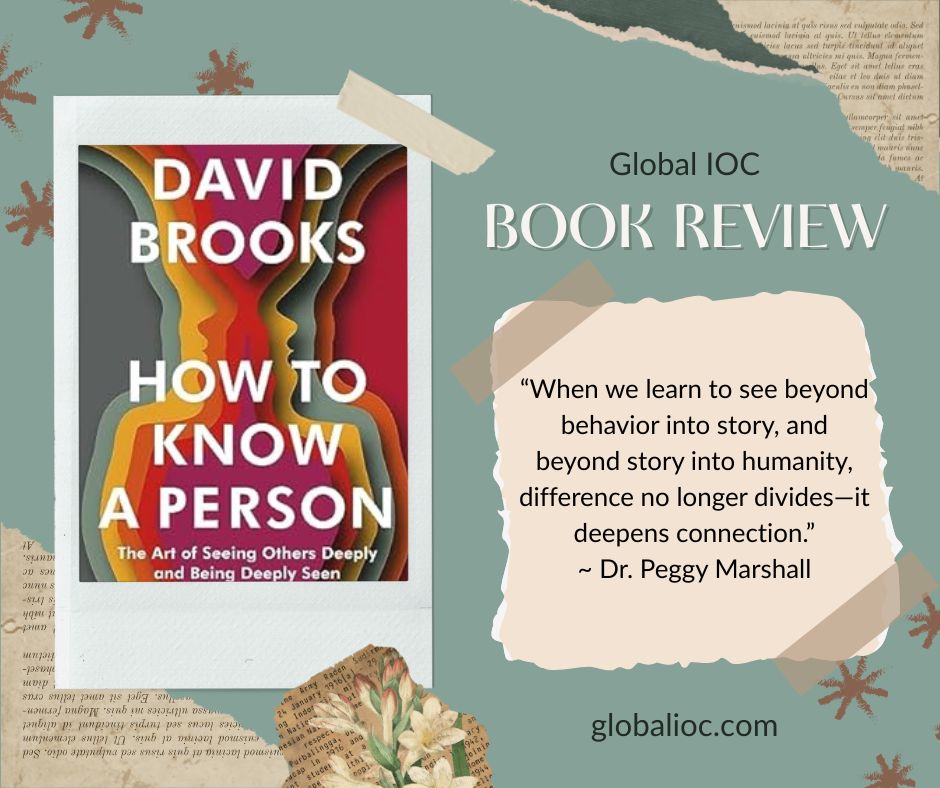
Book Review: How to Know a Person

October 20, 2025 by Dr. Peggy Marshall

In How to Know a Person, David Brooks invites us into one of the most essential relational practices: the art of seeing others deeply and being seen in return. He argues that amid social fragmentation, polarization, and loneliness, the skill of genuine interpersonal connection is exactly what’s missing in our personal, professional, and civic lives. His overarching claim, as noted by Kirkus Reviews, is this:

“There is one skill that lies at the heart of any healthy person, family, school, community organization, or society: the ability to see someone else deeply and make them feel seen—to accurately know another person, to let them feel valued, heard, and understood.”

Brooks structures the book around three parts:

  1. “I See You” – the basic mechanics of noticing, attention, and presence. (Friends Journal)
  2. “I See You in Your Struggles” – how seeing plays out in suffering, difference, vulnerability, and culture. (Friends Journal)
  3. “I See You with Your Strengths” – how seeing someone deeply involves recognizing their potential, their story, and their identity. (Friends Journal)

Along the way, Brooks introduces evocative categories such as “Illuminators” versus “Diminishers,” showing how some people bring out the best in others through the quality of their attention and presence, while others unintentionally shrink those around them through neglect, ignorance, or haste.

While How to Know a Person offers a meaningful framework for how to see others deeply, the book isn’t without its limits. The examples often draw from a fairly narrow, educated milieu, which can make the message feel less universal. The middle chapters also lose some of the clarity and momentum of the opening, veering into loosely connected stories rather than a cohesive argument. Still, the heart of his message—that to know others we must first learn how to see—remains both relevant and resonant, particularly for coaches and leaders seeking to build relational depth and psychological safety.

Key Insights for Coaches and Leaders

Attention matters: If one thing emerged from my reading as a coach and practitioner, it’s this: the nervous system settles when someone feels seen. Brooks’ language supports this truth—seeing isn’t just kind, it’s regulatory.

Beyond technique: Brooks pushes us away from “tips for conversation” toward habits of presence. His distinction between an Illuminator (someone who brings others to life) and a Diminisher (someone who unwittingly shrinks them) aligns beautifully with drama-work: where do we activate connection, and where do we reactivate distance?

Story + identity: Brooks emphasizes that each person “is a point of view. For coaching across difference, this ties directly to meaning-making: to coach another is to step into their lived narrative, not just their immediate behavior.

Universal but personal: Brooks reminds us that this isn’t just about others—it’s also about how we live. He confesses his own journey from being “in my head” to learning to be emotionally available. For leaders, the invitation is clear: reflect on your inner relational stance as much as your outer strategy.

The relational economy: In teams, workplaces, and communities, Brooks’ themes map onto psychological safety, emotional regulation, and meaningful engagement. When people feel seen—especially across difference—they are more likely to engage, innovate, and collaborate.

Closing Reflection

Brooks reminds us that truly knowing another person is both a moral act and a relational discipline. It asks more of us than empathy—it asks presence, humility, and a willingness to let another’s experience expand our own. In coaching and leadership, this becomes the quiet work beneath every conversation: seeing not to fix, but to understand; listening not to respond, but to reveal meaning.

When we learn to see beyond behavior into story, and beyond story into humanity, difference no longer divides—it deepens connection. Brooks’ work reinforces what many of us have discovered through practice: that awareness is the beginning of transformation, and that to help others grow, we must first learn how to see.


Filed Under: Book Reviews

  • « Go to Previous Page
  • Page 1
  • Page 2
  • | Home |
  • Leader Development Pathways
  • | Executive Coaching |
  • Team Coaching
  • | Sustaining Impact |
  • Detach from Drama
  • | Coach Cultures at Global IOC |
  • My Account |

Copyright Global IOC© 2026