• Skip to main content

Global Institute of Organizational Coaching

Global Coaching Certification

  • Explore Pathways
  • Dr Peggy’s Books
  • Resources
  • Log In
  • About

Book Reviews

Book Review – Lead with Purpose: A Story About Leading in Your Personal and Professional Life

February 13, 2025 by Dr. Peggy Marshall

Coaching Corner – Book Review

Lead with Purpose by Dr. Kevin McGarry

Lead with Purpose In Lead with Purpose: A Story About Leading in Your Personal and Professional Life, Dr. Kevin McGarry presents key coaching takeaways through the narrative of Eddie, a corporate leader who becomes the coach of his daughter’s struggling softball team. This journey imparts several valuable lessons:

  1. Adopt a People-Centric Mindset: Eddie learns to prioritize his team’s needs, recognizing that understanding and addressing individual motivations and challenges enhances overall performance.
  2. Embrace Character-Driven Leadership: The story emphasizes leading with integrity and authenticity, demonstrating that a leader’s character profoundly influences team dynamics and success.
  3. Communicate Effectively to Inspire and Motivate: Eddie discovers the importance of clear and empathetic communication, which fosters trust and encourages team members to reach their full potential.
  4. Empower Others by Letting Go of Control – Eddie learns that great leaders don’t micromanage; instead, they trust their team members to step up, make decisions, and grow. By shifting from a directive approach to a coaching mindset, he fosters confidence and ownership among his players.
  5. The Power of Active Listening – One of the biggest transformations Eddie undergoes is learning to truly listen. Rather than jumping in with solutions, he begins asking thoughtful questions and giving his team space to express their thoughts, concerns, and ideas—leading to deeper trust and stronger performance.
  6. Fostering a Growth Mindset – McGarry highlights that successful coaches help their teams embrace challenges as learning opportunities. By encouraging resilience, reframing failures as lessons, and celebrating progress, leaders create an environment where people feel safe to take risks and improve continuously.

These takeaways reinforce McGarry’s core message: leadership is not about having all the answers but about guiding and supporting others to realize their full potential. Additionally, through these insights, McGarry illustrates how coaching, grounded in purpose and character, can transform leadership approaches in both personal and professional contexts.

Available on Amazon

Filed Under: Book Reviews, Corporate Coaching Blog Tagged With: coaching, drama, emotions, misinterpretations, workplace drama

Book Review – How Minds Change by David McRaney

February 24, 2025 by Dr. Peggy Marshall

Coaching Corner - Book Review

How Minds Change by David McRaney


David McRaney’s How Minds Change offers rich insights that can be directly applied to coaching practice, helping you to support your clients in navigating belief systems and fostering transformation. One key takeaway from the book is the understanding that changing one’s mind is rarely a linear process. In a coaching context, this means recognizing that shifts in perspective often require a safe, open space for dialogue and reflection. Coaches can draw on McRaney’s exploration of cognitive dissonance and the gradual nature of belief change to guide clients gently through challenging shifts in thinking, rather than expecting immediate breakthroughs.

The book’s emphasis on the role of persuasion—both as a force for manipulation and as a pathway to genuine transformation—is especially relevant in coaching. By understanding how persuasive narratives, social dynamics, and emotional factors influence decision-making, coaches can help clients identify the external influences that may be reinforcing unhelpful beliefs. This awareness can empower clients to develop greater self-reflection and critical thinking, enabling them to filter out coercive influences and embrace change on their own terms.

Moreover, McRaney’s insights into how open-minded dialogue and reflective self-examination can drive change are invaluable for coaching practice. As a coach, you can model and facilitate conversations that encourage clients to question their assumptions and explore alternative viewpoints. This process not only helps clients gain clarity about their own beliefs but also builds resilience, as they learn that change is both possible and a natural part of growth.

Finally, by integrating the lessons from How Minds Change into your coaching toolkit, you can enhance your ability to tailor interventions based on a deep understanding of human psychology. Whether you’re helping clients overcome limiting beliefs or guiding them through transitions, the book’s blend of research-based insight and relatable storytelling serves as a reminder that transformation is complex, yet accessible through empathetic, evidence-based coaching. Embracing these insights can ultimately lead to more powerful, lasting change in your clients' lives.

To view the entire webinar on this topic, click here.

Filed Under: Book Reviews

Book Review – The Upside of Uncertainty by Nathan Furr & Susannah Harmon Furr

March 3, 2025 by Dr. Peggy Marshall

Coaching Corner - Book Review

The Upside of Uncertainty by Nathan Furr & Susannah Harmon Furr

Overview

The Upside of Uncertainty reframes the unknown as a source of possibility rather than fear. Nathan and Susannah Furr introduce a practical “first-aid cross” model with four key areas—Reframe, Prime, Do, and Sustain—to help individuals and leaders navigate uncertainty with confidence. Drawing from research, interviews, and real-world examples, the authors provide actionable strategies for shifting mindsets, preparing for ambiguity, taking decisive action, and building long-term resilience.

Key Takeaways

  • Uncertainty is Natural and Manageable – Rather than fearing the unknown, embracing it can lead to growth and innovation.
  • Mindset Shapes Experience – Reframing uncertainty as opportunity fosters confidence and adaptability.
  • Practical Strategies Help Navigate the Unknown – Tools like breaking uncertainty into manageable steps and strengthening emotional resilience are essential.
  • Reflection Fuels Growth – Learning from past experiences builds confidence and adaptability for future challenges.

Coaching Tips for Navigating Uncertainty

  1. Reframe Uncertainty as Opportunity
    Help clients shift their perspective by asking:
  • What new doors could this open for you?
  • What’s the best possible outcome in this situation?
  1. Prepare Clients for Ambiguity
    Guide clients to build emotional resilience by:
  • Identifying past successes in uncertain situations.
  • Practicing mindfulness, visualization, and journaling.
  • Establishing routines to maintain stability.
  1. Encourage Small, Intentional Steps
    Overcome indecision by:
  • Taking one small step forward instead of waiting for full clarity.
  • Viewing failures as learning opportunities.
  • Developing an experimental mindset.
  1. Strengthen Decision-Making in Uncertainty
    Support clients by:
  • Using “What if?” scenarios to explore possibilities.
  • Teaching decision-making frameworks (e.g., risk vs. reward).
  • Prioritizing progress over perfection.
  1. Build Emotional Resilience
    Help clients manage stress and uncertainty by:
  • Developing self-awareness of emotional responses.
  • Practicing gratitude, mindfulness, and movement-based coping strategies.
  • Grounding decisions in core values.
  1. Sustain Growth Through Reflection
    Encourage clients to:
  • Keep a “resilience journal” to track past wins.
  • Celebrate small successes to reinforce confidence.
  • Reflect on lessons learned for future challenges.

Final Thoughts

The Upside of Uncertainty offers a hopeful, pragmatic approach to navigating ambiguity. Its insights provide valuable tools for leaders and coaches to transform uncertainty into a catalyst for growth, innovation, and resilience.


Filed Under: Book Reviews Tagged With: ambiguity, growth, opportunities, track your wins, uncertainty

Book Review – Summary of Martin Seligman’s Well-being Trilogy

March 11, 2025 by Dr. Peggy Marshall

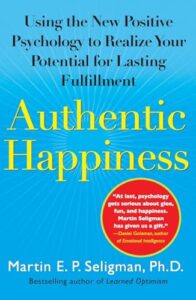
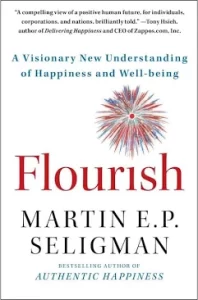
Martin Seligman, the father of positive psychology, has written several groundbreaking books that explore happiness, optimism, and well-being. His three most influential works—Learned Optimism, Authentic Happiness, and Flourish—trace the evolution of his research and offer practical strategies for building a meaningful and fulfilling life.

1. Learned Optimism (1991)

Theme: How Optimism Shapes Success and Well-being
Learned Optimism explores how our thinking patterns affect our resilience, mental health, and success. Seligman argues that pessimism is not fixed—it is learned, and therefore, it can be unlearned. He introduces strategies to shift from a pessimistic to an optimistic mindset, leading to better mental health, performance, and overall life satisfaction.

Key Insights:

  • ✅ Explanatory Style Matters – How we interpret events affects our well-being.
  • ✅ Optimism Can Be Taught – Through cognitive reframing, individuals can change their thought patterns.
  • ✅ Optimism Improves Performance – Optimists are more resilient, have higher work performance, and experience lower rates of depression.

2. Authentic Happiness (2002)

Theme: The Science of Happiness and Well-being
Authentic Happiness expands on Seligman’s optimism research by introducing positive psychology—a new approach that shifts the focus of psychology from fixing problems to enhancing strengths. He presents a research-backed happiness model based on three pillars: The Pleasant Life, The Engaged Life, and The Meaningful Life.

Key Insights:

  • ✅ Happiness is Not Just About Feeling Good – Purpose and engagement matter more than pleasure alone.
  • ✅ Signature Strengths Enhance Well-being – Identifying and using your natural strengths leads to greater happiness.
  • ✅ Positive Psychology Can Improve Work and Relationships – Applying these principles enhances engagement and fulfillment.

3. Flourish (2011)

Theme: Well-being as a Holistic, Multi-Dimensional Concept
In Flourish, Seligman moves beyond happiness and introduces the PERMA model—a more comprehensive framework for well-being: Positive Emotions, Engagement, Relationships, Meaning, and Accomplishment.

Key Insights:

  • ✅ Well-being is More Than Just Happiness – True fulfillment comes from meaning, engagement, and relationships.
  • ✅ PERMA is a Roadmap to Lasting Well-being – Focusing on all five elements leads to a more balanced, fulfilling life.
  • ✅ Positive Psychology in Schools & Workplaces – Real-world applications of positive psychology in education, business, and leadership.

Final Verdict: Which Book Should You Read?

📌 Want to build a more optimistic mindset? → Learned Optimism

📌 Looking for an introduction to happiness science? → Authentic Happiness

📌 Seeking a complete framework for well-being? → Flourish

Together, these books offer a transformative roadmap for resilience, happiness, and long-term fulfillment. Whether you’re an individual seeking personal growth or an HR leader looking to enhance workplace well-being, Seligman’s research provides invaluable insights that reshape how we approach happiness and success.

Filed Under: Book Reviews Tagged With: Authentic Happiness, Flourish, learned optimism, Martin Seligman

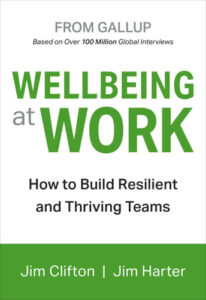
Book Review: “Wellbeing at Work” by Jim Clifton and Jim Harter

March 25, 2025 by Dr. Peggy Marshall

"Wellbeing at Work: How to Build Resilient and Thriving Teams" by Jim Clifton and Jim Harter is a thought-provoking and practical guide that emphasizes the vital role of employee well-being in organizational success. Published by Gallup Press, the book leverages decades of Gallup research to build a compelling case for prioritizing well-being as an essential leadership strategy. The authors make it clear that investing in well-being is not just beneficial for employees but also fundamental for driving performance, engagement, and long-term sustainability.

One of the book’s central themes is the introduction of five core elements of well-being: Career Well-Being, Social Well-Being, Financial Well-Being, Physical Well-Being, and Community Well-Being. According to Clifton and Harter, these elements are crucial for creating resilient and thriving teams. Career Well-Being focuses on finding meaning and purpose in daily work, while Social Well-Being emphasizes building strong and supportive relationships. Financial Well-Being is about managing finances effectively to reduce stress, and Physical Well-Being centers on maintaining good health and energy through positive habits. Lastly, Community Well-Being highlights the importance of feeling connected and contributing to one’s community. The authors argue that when these five elements are prioritized, employees not only perform better but also experience higher satisfaction and engagement.

A key message of the book is the pivotal role that leadership plays in fostering well-being. Clifton and Harter stress that leaders must go beyond traditional management and evolve into coaches who mentor and guide their teams toward building resilience and thriving both personally and professionally. Leaders are encouraged to model healthy behaviors, practice empathy, and actively support their teams in adopting well-being practices. By doing so, they create a workplace culture that values well-being as an integral part of daily operations rather than a mere add-on.

Another powerful aspect of the book is its focus on leveraging individual strengths through the Clifton Strengths assessment. The authors advocate for a strengths-based approach, where employees are encouraged to develop and use their unique strengths consistently. This approach fosters higher morale, motivation, and job satisfaction, while also aligning individual potential with organizational goals. By integrating strengths-based practices into well-being strategies, leaders can help their teams feel more confident and engaged.

The book goes beyond theory by offering practical strategies to implement well-being initiatives effectively. Some of the actionable recommendations include creating flexible work arrangements to alleviate stress, offering financial literacy programs to enhance financial security, fostering open communication and psychological safety, and building a culture of recognition and gratitude. Additionally, the authors highlight the importance of wellness programs that address both physical and mental health needs. These practical applications make the book a valuable resource not only for leaders but also for coaches and HR professionals seeking to build and sustain a well-being-centered culture.

Clifton and Harter’s message is clear: well-being is not a luxury or a trendy initiative but a fundamental component of sustainable leadership. By placing well-being at the heart of organizational strategy, leaders can build resilient, engaged, and high-performing teams. The book challenges outdated leadership models by emphasizing a human-centric approach that prioritizes people over processes.

"Wellbeing at Work" is more than just a guide; it is a call to action for leaders to rethink how they support their employees. Through data-driven insights, real-world examples, and practical advice, the authors make a strong case for making well-being a core organizational priority. Whether you’re a leader, a coach, or an HR professional, this book will inspire you to adopt new strategies that foster a thriving workplace. It’s a highly recommended read for anyone committed to sustainable leadership and team success.


Filed Under: Book Reviews Tagged With: sustainable change, team building, wellbeing, wellbeing at work, workplace environment

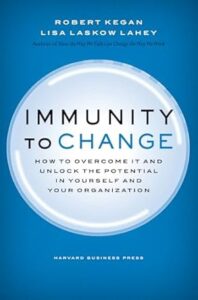
Book Review: Immunity to Change

April 7, 2025 by Dr. Peggy Marshall

Book Review: Immunity to Change

Why this classic on personal and organizational transformation still matters—especially when we’re trying to sustain impact.

One of the most common misconceptions about change is that once people are motivated and committed, the change will naturally stick. But as anyone who’s led or lived through transformation knows, that’s rarely the case. This is exactly the tension that Immunity to Change by Robert Kegan and Lisa Lahey explore with insight, depth, and compassion. And it’s why this book remains a foundational resource for anyone serious about not just starting change but sustaining it.

Immunity to Change begins with a simple but profound observation: people and organizations often fail to follow through on their best intentions, not because they’re lazy or uncommitted, but because they are unconsciously protecting something. Kegan and Lahey call this protection system an “immunity to change.” It’s a psychological defense, often invisible to the individual, that functions much like the immune system in your body: it resists what it perceives as a threat, even if that “threat” is the very change you’re trying to create.

This concept alone shifts the narrative from one of judgment (“Why can’t I just do it?”) to one of curiosity and compassion: “What am I protecting, and why?” The authors introduce a practical, step-by-step method for identifying your stated goal (what you want to change), the behaviors that contradict that goal, the hidden commitments driving those behaviors, and the big assumptions underlying those hidden commitments.

This framework is both elegant and confronting. It helps people name the internal conflicts that quietly undermine their progress, often rooted in fear, self-protection, or outdated narratives. For example, a leader might want to empower their team but continue micromanaging. A coach might want to grow their practice but avoid visibility. A team might want to innovate but cling to familiar ways of working. Once these underlying commitments and assumptions are surfaced, change can finally move from aspiration to integration.

Kegan and Lahey’s work offers a powerful complement to the Sustaining Impact process. It reinforces a core truth, insight is not enough. Sustained change requires awareness of the invisible forces working against your best intentions. This book lives squarely in the Clearing and Courage phases of the Sustaining Impact process—Clearing, because it helps identify and release unconscious blocks, and Courage, because surfacing your inner resistance takes honesty, self-awareness, and emotional resilience.

Importantly, it reminds us that resistance isn’t the enemy, it’s information. Once seen clearly, it becomes a doorway to deeper transformation. This book is a must-read for coaches looking to help clients unlock what’s really holding them back, for leaders who feel stuck in patterns despite clear vision and intention, for teams navigating cultural or strategic shifts that just won’t stick, and for anyone who’s tired of repeating the same patterns and ready to look deeper.

It’s not a quick read, but it’s a transformational one. It requires you to slow down, reflect deeply, and engage with your inner world. But the result is a change that’s not just possible, it’s durable.

Immunity to Change doesn’t promise fast fixes. What it offers instead is something far more valuable: a deeper understanding of what gets in our way—and a practical path to move through it. If you're serious about sustaining impact, this book will help you do the inner work that makes outer change truly possible.


Filed Under: Book Reviews

Book Review: Playing Big by Tara Mohr

May 28, 2025 by Dr. Peggy Marshall

Silencing the Inner Critic and Stepping Into Your Voice

Playing Big Book coverIn a world that often encourages us to play it safe, stay small, and second-guess our brilliance, Playing Big by Tara Mohr is a powerful guide for anyone ready to do the deeper inner work of showing up fully and unapologetically.
Mohr’s approach isn’t about hustle or hype it’s about returning to your inner knowing, quieting the voice of fear, and learning to trust your own wisdom. At the heart of the book is her framework for identifying and gently disarming the inner critic, a voice many of us have internalized so deeply that we mistake it for truth. With compassion and clarity, she invites readers to differentiate between the voice of self-doubt and the quieter, wiser voice within the “inner mentor.”

Throughout the book, Mohr integrates personal stories, client experiences, and accessible tools that help readers move from hesitation to action. Her reflections on unhooking from praise and criticism, navigating fear, and communicating with clarity and power are particularly relevant for leaders, creatives, and anyone working to align their outer impact with their inner truth.

For coaches, this book offers not just insights, but practices and tools you can use with clients to help them name their inner critic, shift limiting narratives, and play bigger on their own terms. It’s also an ideal companion for those navigating career change, visibility blocks, or seasons of reinvention.

Playing Big doesn’t promise instant confidence. What it offers instead is something far more sustainable: a grounded, wise, and courageous path toward self-trust.


Filed Under: Book Reviews

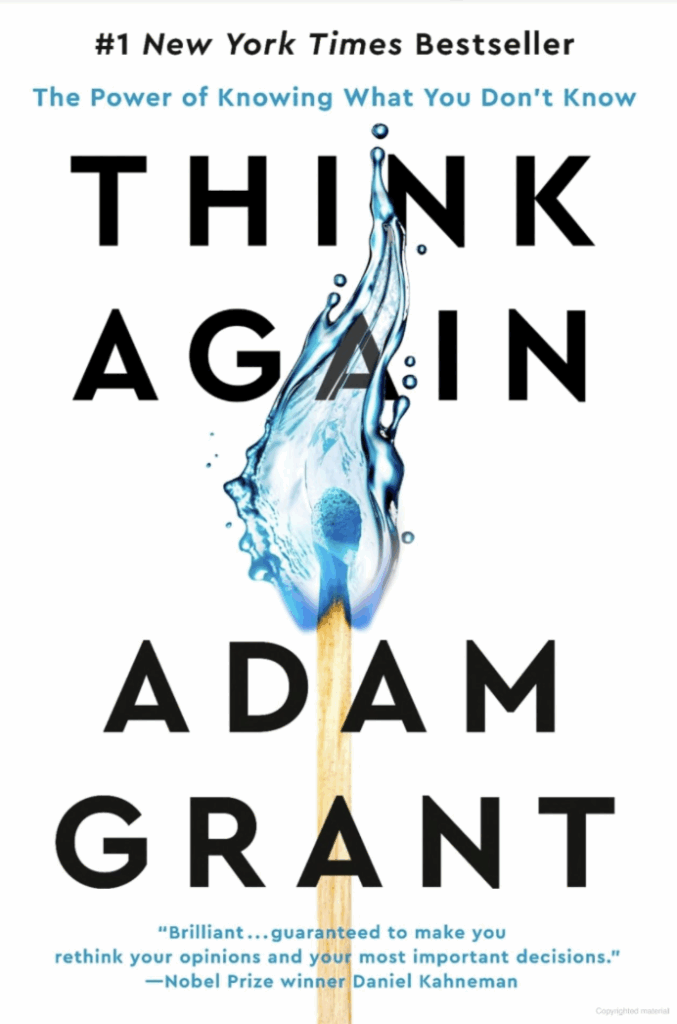
Think Again by Adam Grant

August 4, 2025 by Dr. Peggy Marshall

A Reflective Book Review for Leaders and Coaches

We live in a world that often rewards confidence more than curiosity, where being right can seem more valuable than being open. In Think Again, organizational psychologist Adam Grant invites us to consider a different path—one where wisdom comes not from holding tightly to our beliefs, but from the courage to question them.

At its core, Think Again is about the power—and the necessity—of rethinking. Grant makes a compelling case that our ability to revisit, revise, and sometimes even relinquish our ideas is one of the most important skills we can cultivate in a rapidly changing world. Whether we’re leading teams, parenting children, navigating conflict, or making personal decisions, the ability to pause and ask, “What if I’m wrong?” becomes a gateway to growth.

What makes this book especially timely is its relevance across domains. Grant explores rethinking on three levels: within ourselves, in our conversations with others, and in the cultures we create. Along the way, he introduces us to the mindsets that can keep us stuck—what he calls the Preacher, Prosecutor, and Politician modes of thinking. The preacher defends sacred beliefs. The prosecutor attacks opposing views. The politician seeks approval. All of them, he argues, make it harder to truly learn. The alternative? Thinking like a scientist—curious, humble, and grounded in the willingness to change one's mind in light of new evidence.

For those of us in leadership or coaching roles, this book offers not just insight but challenge. Grant reminds us that certainty is seductive, especially when we’re seen as experts or decision-makers. But confident humility—the ability to know what we know while staying open to what we don’t—may be the more powerful stance. In one of the book’s most memorable sections, he describes how effective leaders create space for dissent, invite counterviews, and model learning aloud, even in high-stakes environments.

Grant doesn’t preach from a distance. He shares stories of entrepreneurs who avoided collapse by questioning their own business models, teachers who transformed classrooms by normalizing mistakes, and individuals who used the tools of motivational interviewing to shift conversations that might otherwise have stalled in defensiveness. These examples, woven with research from behavioral science and psychology, offer a hopeful reminder: change is possible—even when it’s hard.

What stays with me most after reading Think Again is not a single framework or technique, but a feeling—a kind of quiet encouragement to lead with less armor and more openness. In a culture that often equates changing your mind with weakness, Grant argues that rethinking is a strength, a sign not of indecision but of wisdom.

For coaches, facilitators, and anyone guiding others through change, this book is more than useful—it’s resonant. It speaks to the practice of holding space for others to see what they couldn’t yet see, and to do the same for ourselves. As Grant writes, “If knowledge is power, knowing what we don’t know is wisdom.”

And perhaps, in the end, that’s the invitation: not just to think again, but to live again—more flexibly, more relationally, and more courageously.


Filed Under: Book Reviews Tagged With: Adam Grant, Think Again

  • Page 1
  • Page 2
  • Go to Next Page »
  • | Home |
  • Leader Development Pathways
  • | Executive Coaching |
  • Team Coaching
  • | Sustaining Impact |
  • Detach from Drama
  • | Coach Cultures at Global IOC |
  • My Account |

Copyright Global IOC© 2026