
From Leadership Capability to Organizational Capacity
Organizations invest heavily in developing capable leaders. They strengthen strategic thinking, emotional intelligence, coaching capability, decision making, collaboration, and self-awareness, often with good reason. Leadership matters.
But there is another question we ask far less often:
What kind of organization are we asking those leaders to lead within?
A leader may learn to distribute authority while working inside a system that continues to centralize decisions. A leader may become more skilled at creating candid dialogue while operating within a culture where speaking honestly still carries risk. A leader may learn to think systemically while performance measures continue rewarding functional success over enterprise contribution. A leader may become increasingly clear about values and purpose while watching organizational decisions repeatedly contradict what the organization says it stands for.
At some point, developing the leader is no longer enough.
The organization itself has to become visible.
The Aligned Organization™ provides a way to examine the organizational conditions that shape how work actually gets done: how decisions are made, how information moves, how power is exercised, how accountability is experienced, how functions work across boundaries, how values hold under pressure, and whether the organization is creating the conditions necessary to sustain the leadership and performance it expects.
You cannot map the terrain without first excavating the patterns beneath it.
Schedule an Alignment Conversation
What Is Your Organization Actually Producing?
When organizations struggle with execution, collaboration, accountability, engagement, or culture, attention naturally turns toward people.
Do our leaders need more development? Do managers need to hold people more accountable? Are employees resistant to change? Does this team need to communicate better? Is that function creating the problem?
Sometimes the answer is yes.
But when the same concerns continue appearing across different teams, leaders, initiatives, and years, they begin to tell us something else. What appears to be an individual or leadership problem may actually be a pattern the organization itself is helping to produce.
Consider four concerns shared by organizations across industries and levels of complexity:
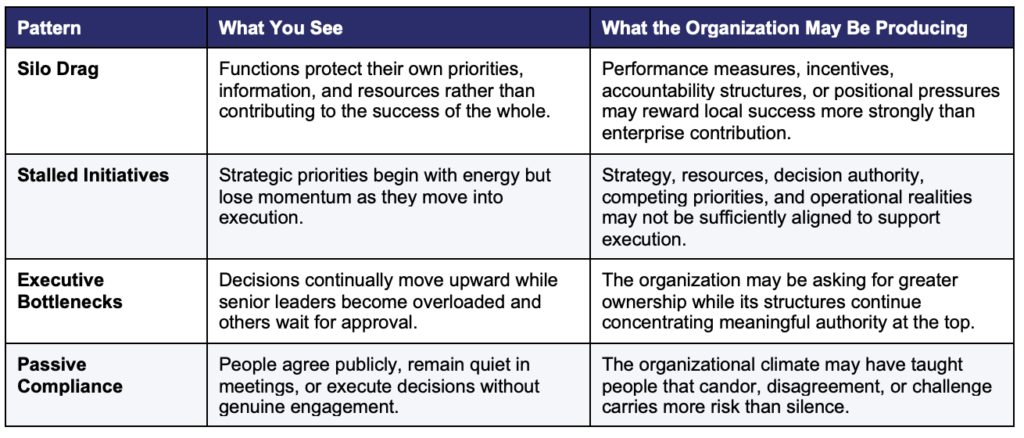
These are not simply failures of individual capability. They are clues to the system.
A silo can be filled with highly collaborative people. An executive bottleneck can exist around a leader who genuinely wants others to take greater ownership. Employees can understand the importance of candor while also knowing from experience that certain truths are safer left unsaid.
Once we begin seeing these concerns as organizational patterns rather than isolated performance problems, the inquiry changes.
Instead of asking only:
Who is causing the problem?
We begin asking:
What is the organization producing?
That question takes us beneath the visible symptoms and into the organizational terrain shaping them.
See the Organization You Are Actually Leading
The Aligned Organization Diagnostic & Action Plan™
The Aligned Organization Diagnostic & Action Plan is designed to make lived organizational reality visible.
It examines how the organization is actually experienced across levels, functions, and roles, not simply how its structures, culture, leadership expectations, or values are intended to operate.
The diagnostic helps organizations answer questions such as:
- Where are structures or operating practices creating unnecessary friction?
- Where is decision authority clear, and where is it creating dependency or delay?
- Where do different levels of the organization experience culture, accountability, trust, and leadership differently?
- Where are information flows strengthening System Sight, and where are important perspectives being lost?
- Where do stated values and everyday organizational practices reinforce one another, and where do they diverge?
- Where is power expanding ownership and capability, and where is it unintentionally constraining them?
- Which patterns are isolated, and which are being reproduced across the system?
- Where would focused intervention have the greatest potential to strengthen organizational alignment?
The purpose is not to tell an organization whether it is good or bad, healthy or unhealthy.
It is to help the organization see itself more completely.
Because until the patterns become visible, organizations can spend enormous amounts of time trying to solve the symptoms they produce.
Schedule an Alignment Conversation
The Architecture of an Aligned Organization
The Aligned Organization examines organizational capacity through three mutually reinforcing domains: Identity & Self-Governance, System Sight & Relational Depth, and Collective Impact & Responsible Power.
These domains also sit within the broader Global IOC architecture, but here the unit of analysis changes.
The question is no longer whether an individual leader possesses these capacities.
The question is whether the organization does.
These are the same twelve capacities the Generative Leadership™ Profile examines in individual leaders, applied here as properties of the organization itself, not the person leading within it.
Identity & Self-Governance
Does the organization operate from the identity it claims?
Organizations communicate purpose, values, priorities, and expectations constantly. Identity & Self-Governance examines whether those commitments remain visible in the choices the organization actually makes, particularly when pressure increases.
It asks whether strategy, leadership behavior, operating rhythms, resource decisions, cultural expectations, and everyday practice reinforce a coherent organizational identity or pull against one another.
The real test of organizational identity is rarely what appears on the wall. It is what happens when a deadline is missed, revenue is threatened, priorities compete, resources become scarce, a customer pushes back, or leaders face a decision in which expedience and values point in different directions.
Identity becomes organizational when people do not have to guess which version of the organization will appear under pressure.
System Sight & Relational Depth
Can the organization see what is actually happening within itself?
Organizations generate enormous amounts of information, but information alone does not create System Sight.
System Sight & Relational Depth examines whether the organization can recognize recurring patterns, understand interdependencies, hear perspectives across levels and functions, and distinguish visible events from the conditions producing them.
The same organization can look remarkably different depending on where someone sits within it. Executives, middle managers, frontline employees, functional leaders, and customers occupy different positions and therefore encounter different parts of the system.
An organization develops System Sight when those perspectives can inform one another rather than compete to define reality.
This changes the quality of organizational inquiry. A missed deadline becomes more than an execution failure. Persistent conflict between two functions becomes more than a relationship problem. Silence in a meeting becomes more than disengagement.
Each becomes information about the system.
Collective Impact & Responsible Power
Does the way the organization uses power expand or constrain its collective capacity?
Every organization distributes authority, influence, resources, voice, and decision rights, whether it does so intentionally or not.
Collective Impact & Responsible Power examines what those distributions produce.
An organization can tell people to take ownership while requiring multiple levels of approval before they can act. It can ask managers to develop their people while rewarding them primarily for individual execution. It can encourage employees to speak candidly while allowing disagreement with authority to carry relational or career consequences.
Responsible power is not the elimination of hierarchy. Organizations require roles, boundaries, accountability, and legitimate authority.
The question is whether those structures strengthen the capacity of the whole.
When power is exercised responsibly, people understand where authority lives, decisions can move closer to the work when appropriate, accountability accompanies agency, and leadership capacity is not concentrated in a small number of individuals at the top.
What the Diagnostic Examines
The Aligned Organization Diagnostic translates these three domains into twelve organizational competencies, creating a comprehensive view of the conditions shaping how the organization actually operates.
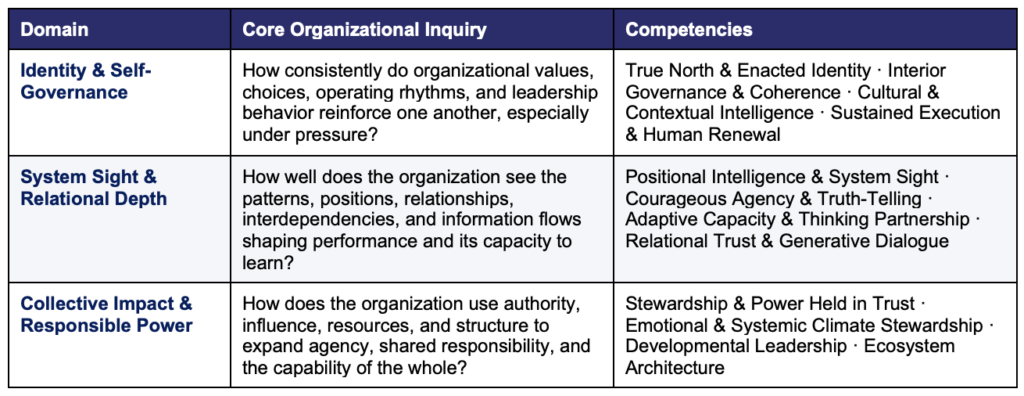
The value lies not simply in an overall assessment. It lies in seeing where experiences converge and where they do not.
Executives may believe decision authority is distributed while managers experience continual escalation. Senior leaders may experience the culture as candid while people closer to the work experience significant risk in challenging a decision. One function may experience strong cross-enterprise collaboration while another operates inside persistent structural friction.
Those differences are not noise in the data.
They are part of the terrain.
What the Diagnostic Makes Visible
The Aligned Organization Diagnostic provides a view of how the organization is currently operating across Identity & Self-Governance, System Sight & Relational Depth, and Collective Impact & Responsible Power.
It reveals where patterns remain largely beneath the surface, where they are becoming visible, where intentional alignment is developing, and where aligned practices have become embedded in how the organization operates.
Positional differences matter because organizations do not experience themselves uniformly. Where someone sits in the system shapes what they can see, what pressures they carry, what information reaches them, what authority they hold, and how they experience the culture around them.
The diagnostic brings those perspectives into view together.
Rather than reducing the organization to a single judgment about whether it is aligned or misaligned, the diagnostic creates a more complete picture of the organizational terrain and allows leaders to ask:
What is happening in our organization, where is it happening, and what conditions are producing it?
That is where meaningful organizational development can begin.
From Diagnostic to Action
Assessment without action simply gives an organization more information.
The Aligned Organization Diagnostic therefore leads into an Action Plan designed around the patterns revealed in the organization itself.
The goal is not to launch another enterprise-wide initiative or impose a generic transformation model. It is to identify where organizational conditions are supporting alignment, where they are constraining it, and where focused attention can create meaningful movement.
That work follows the developmental architecture that underlies the broader Global IOC ecosystem:
Awareness: Seeing the System
The organization begins by making its current terrain visible: patterns, structural friction, positional differences, information flows, relationships, operating practices, and distributions of power that may previously have remained beneath the surface.
Activation: Changing the Conditions
Leaders determine which conditions require attention and begin intentionally reshaping the structures, practices, relationships, decision processes, or operating rhythms that are reinforcing patterns the organization no longer wants to sustain.
Alignment: Building Organizational Capacity
The work becomes embedded in how the organization learns, decides, adapts, collaborates, and exercises leadership over time. Alignment becomes less dependent on extraordinary individual effort because the system itself is increasingly capable of supporting it.
The objective is not organizational perfection.
It is an organization increasingly capable of seeing itself, learning from what it sees, and intentionally shaping what it produces.
Developing Leaders Is Only Half the Equation
Organizations need capable leaders.
But they also need organizational environments capable of sustaining what those leaders are being developed to do.
That is the distinction between Generative Leadership™ and The Aligned Organization™.
Generative Leadership develops and assesses the capacities leaders bring to the system.
The Aligned Organization examines whether the system itself possesses the identity, System Sight, relational depth, structures, and responsible use of power necessary to support those capacities in practice.
One develops the leader.
The other examines the terrain in which leadership must live.
Together, they allow us to ask the question that has been missing from much of leadership development:
What are we developing in our leaders, and what kind of organization are we asking them to lead within?
Begin by Seeing the System
The Aligned Organization Diagnostic & Action Plan provides a starting point for organizations ready to understand the patterns beneath their current performance and identify where greater alignment can create meaningful movement.
Schedule an Alignment Conversation