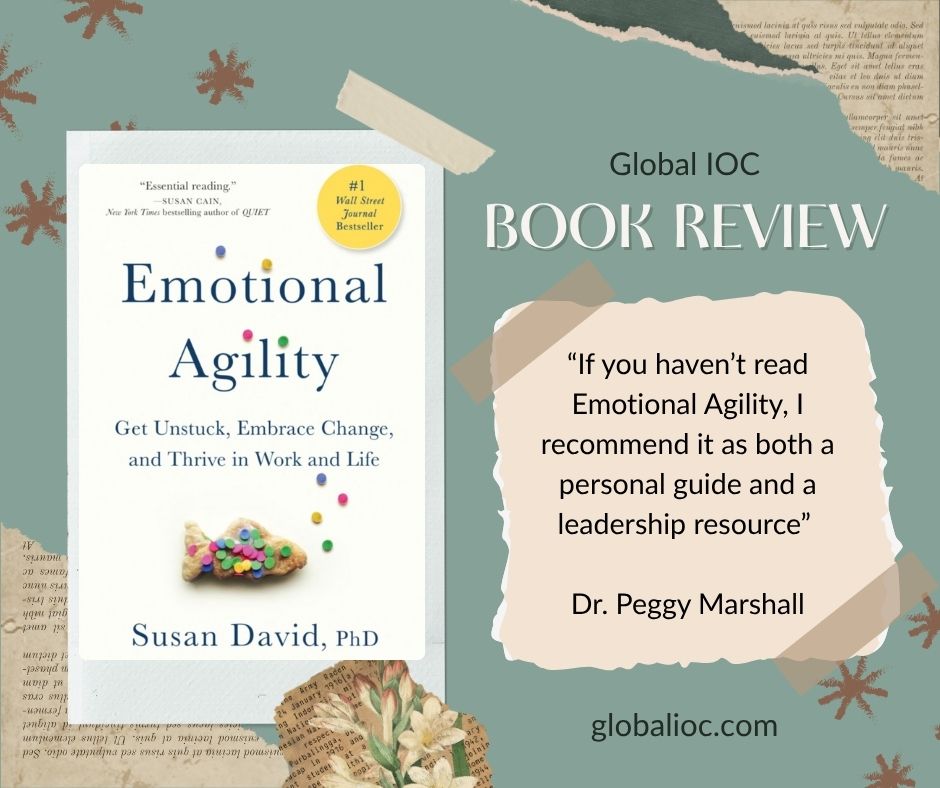
In today’s workplaces, technical skill alone isn’t enough. Leaders are called on to navigate ambiguity, high-pressure change, and the unpredictable human side of collaboration. In Emotional Agility, Harvard psychologist Susan David offers a research-based framework for one of the most critical—and overlooked—leadership capacities: the ability to work with emotions rather than be driven by them.
David defines emotional agility as the ability to be with your thoughts, feelings, and stories in a way that is flexible, values-driven, and constructive. In other words, it’s the skill of working with your internal experience rather than being run by it.
She identifies two traps that derail emotional agility:
- Hooking – This happens when a thought or feeling grabs hold of you and drives behavior without reflection. You might find yourself replaying a perceived slight from a meeting, or making a decision out of frustration rather than careful consideration. Hooking often comes with urgency—the impulse to act now, defend yourself, or shut someone down—without pausing to ask if that’s really the most effective choice.
- Fusion – Here, we merge with our thoughts and treat them as absolute truth. If you think, “They don’t respect me,” fusion makes it feel indisputable, even when it’s one interpretation among many. Fusion keeps us locked into one perspective and blinds us to nuance or alternative explanations.
David’s alternative is a process of four key practices that together create the flexibility, perspective, and values alignment leaders need.
- Showing Up – Rather than avoiding discomfort or trying to project “everything’s fine,” showing up means acknowledging what you feel—anger, anxiety, disappointment—and allowing it into your awareness without shame. In leadership, this builds authenticity and trust, showing others that emotions are part of the work, not a weakness to hide.
- Stepping Out – This is the mental shift from being inside the thought or feeling to observing it. You might notice, “I’m feeling defensive right now,” which creates distance and reduces the automatic power of the reaction. This is where reflection begins.
- Walking Your Why – Values become your compass here. When emotions are running high, asking “What matters most in this situation?” helps align your response with your deeper principles rather than your momentary reactions.
- Moving On – Emotional agility doesn’t mean waiting until the feeling passes; it’s about taking small, intentional steps that honor your values even while discomfort is present. Leaders who can “move on” demonstrate resilience and model for others that progress is possible without perfection.
For leaders, these skills are game-changing. Emotional agility allows you to respond to feedback without defensiveness, handle conflict without escalation, and remain grounded in the face of change. It’s the difference between being reactive in the moment and being responsive in service of the bigger picture.
At Global IOC, we see emotional agility as a cornerstone of coaching cultures. That’s why both our Registered Professional Coach (RPC) and Senior Registered Professional Coach (SRPC) programs include a full module dedicated to developing it. In these programs, we go beyond the theory—helping leaders apply emotional agility in real time:
- Recognizing when they’re hooked by a narrative or reaction.
- Practicing how to “step out” and create space between emotion and action.
- Using values-based alignment to guide team decisions and conversations.
- Building resilience by moving forward with small, meaningful shifts rather than waiting for the “perfect” solution.
This applied practice turns emotional agility from a personal competency into an organizational capability. When leaders model it, teams learn that emotions are not to be avoided, but understood and navigated. This creates a foundation of psychological safety, innovation, and adaptability—qualities every organization needs in today’s environment.
If you haven’t read Emotional Agility, I recommend it as both a personal guide and a leadership resource. And if you want to move from reading about it to living it in your leadership and coaching, our RPC and SRPC programs are the next step.